
Fact-sheet: Chiari malformation
Updated on 01/06/2023 at 11:04 AM
View all RADEOS cases associated with this fact-sheet
Definition
Group of congenital anomalies characterized by a small posterior fossa with caudal displacement of the cerebellum +/- brainstem.
Possible predisposing genetic or ethnic factors.
Associated spinal-cord malformations may be present.
Clinical features
Depends on age:
- Infant: hydrocephalus
- Adolescent and young adult: vertigo with head rotation, quadriparesis, quadriparesthesias, drop attacks, bulbar syndrome, mixed cranial nerve involvement
Radiography
Possible associated bony anomalies:
- Lacunar skull, clivus scalloping,
- Atlas: occipitalization, hypoplasia,
- Axis: basilar invagination, C2-C3 fusion.
- Klippel-Feil syndrome
MRI
Reference imaging modality
- Small posterior fossa
- Short clivus, low insertion of the straight sinus, low position of the tentorium cerebelli
- Prolapse of the cervicomedullary junction and cerebellar tonsils into the spinal canal
- Herniation of the superior vermis through the enlarged foramen ovale
- Development of the cerebellar flocculi around and anterior to the medulla
- Triangular deformity of the quadrigeminal plate
- Ventricular dilatation of the occipital horns
- Aqueduct of Sylvius malformed or compressed anteroposteriorly
- Hypertrophy of the interthalamic adhesion
- Fusion of the thalami
- Agenesis of the falx cerebri
- Hydromyelia
- Tethered spinal cord, spina bifida, Diastematomyelia, Myelomeningocele
Management
Surgical treatment:
- Decompression of neural structures by opening the posterior arch of the atlas and the foramen magnum
- CSF diversion by ventriculoperitoneal shunt
Classification
Type 1: cerebellar tonsillar ectopia below the foramen magnum (greater than 6 mm in children and 3 mm in adults) +/- Syringomyelia
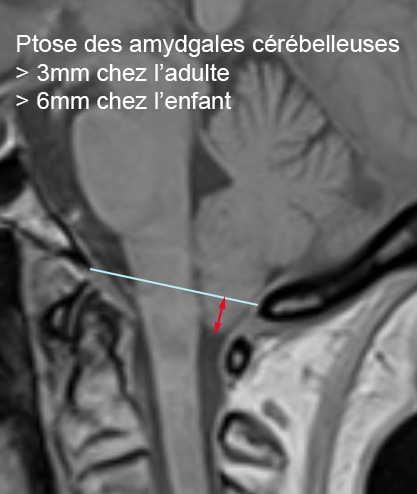
Type 2: malposition of the medulla, fourth ventricle, and cerebellar vermis into the cervical canal, most often associated with Myelomeningocele +/- low insertion of the tentorium cerebelli, dilatation of the atrium, beaked appearance of the tectum, hypertrophy of the massa intermedia, fenestration of the falx cerebri, Agenesis of corpus callosum, hydrocephalus or hydrosyringomyelia
Type 3: malposition of all posterior fossa structures into the cervical canal + occipitocervical encephalomeningocele
Type 4: severe cerebellar hypoplasia without caudal displacement of the cerebellum. Likely represents a variant of cerebellar hypoplasia
Type 5: absence of the cerebellum and herniation of the occipital lobe through the foramen magnum